PAX Transactions
Review PAX activity under Owner's Portal > Payments > PAX in the Back Office . PAX transactions and batches share this tab.
Choose a task
- Store — review individual terminal transactions.
- Batch — reconcile manually closed terminal batches.
This tab shows the approved card transactions and the manual batch closes from your PAX terminals. Use it daily to reconcile what the POS recorded against what your processor deposited.
Transactions
Choose a business day to see its transactions. Only approved transactions are listed: declined attempts and terminal errors are left out. Each PAX terminal gets its own card, titled Terminal and the terminal’s serial number. If no terminal ran a card that day, the section shows No transactions. While a day loads, the section shows loading dots. If the day fails to load, it shows the error in red instead; reload the page to try again.
| Field | Description |
|---|---|
Time | When Selflane recorded the transaction, in your business time zone. |
Order | The order number, plus a check number when the order is split, such as #1042 · check 2. When the transaction is linked to an order, click the number to open it. With no order number, it shows the terminal’s reference number instead. |
Card | Last 4 digits of the customer card. |
Name | The cardholder name, when the terminal reports one. |
Amount | Total of the transaction, including adjusted tip. |
Tip | Adjusted tip amount. |
Status | The transaction type, such as Sale, Adjust, Void, or Return. Voids are shaded. |
Auth Code | 6-character authorization code from the processor. |
Transaction ID | Per-terminal transaction number. Resets to 1 after each batch close. A sale and its later tip adjustment share one Transaction ID. |
Batch | The batch number this transaction belongs to. Some processors (such as Heartland) don’t expose a local batch number. |
Name, Tip, Auth Code and Transaction ID are hidden when no transaction in that terminal’s table fills them, such as Name when the terminal reported no cardholder names. The other columns always show, so terminals on the same day can show different columns.
Compact shows one row per transaction: its latest tip adjustment, or its latest record when it has no adjustment. Standard shows every sale and adjustment. Click a row to see the transaction details.
Search and download
Use the search box to narrow the list. Enter 4 digits to match a card’s last 4, or # and an order number (such as #1042) to match that order. Anything else matches the amount, tip, order, card, name, status, auth code, transaction ID, or batch. Use the download button under each terminal’s table to save it as a CSV or PDF file.
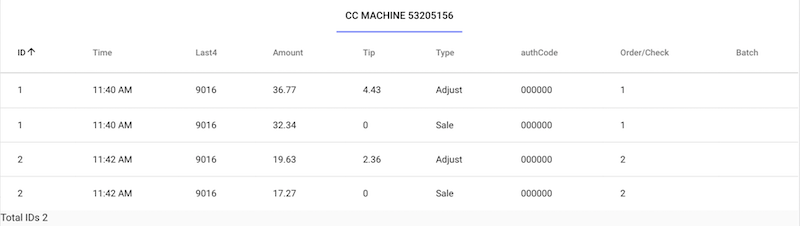
Batch summary
Under each terminal’s table, a row of tiles sums up each batch that ran on that terminal that day. Tip adjustments aren’t counted, so a sale and its adjustment count once. The summary always covers the terminal’s whole day, whatever you search or whichever of Compact and Standard you pick.
Batch- the batch number.Count- how many transaction IDs the batch has.Range- the lowest and highest transaction ID, such as1 - 42.Missing- transaction IDs insideRangethat have no record in Selflane. Shows only when some are missing.Voids- transaction IDs that were voided. Shows only when the batch has voids.
Transaction IDs run in order within a batch, so a number in Missing can mean the terminal approved a transaction that the POS never sent to Selflane. A declined card may also leave a gap. If you see one:
- Check the next business day. A transaction the POS uploaded late shows on the day Selflane received it.
- Look up that transaction ID in your processor’s report for the batch.
- If it’s an approved sale, find the order it belongs to and check that the order shows the card payment.
- If the payment isn’t on any order, contact Selflane support with the terminal serial number and the transaction ID.
Selflane also checks for gaps as each transaction arrives. When it finds one, it asks the POS to reload that transaction from the terminal. If the transaction comes back within a day and is an approved sale that matches its order, Selflane adds the payment to the order and leaves a note on it. Anything else goes to Selflane support for review.
The summary skips transactions without a batch number, so Heartland terminals show no summary.
Transaction details
Click a row to open Transaction Detail:
Transaction ID,Last 4,Name,Amount,TipandAuth Code- the same values as the table.Type- the transaction type, the same asStatusin the table.Host Code- the reference code from the processor’s host.Order- the order and check number. Shows only when the transaction has an order number.Terminal ref- the terminal’s reference number for the transaction.IP- the terminal’s IP address.Batch- the batch number.Processed time- when the terminal processed the transaction.Created at- when Selflane recorded it, in your business time zone.
Processed time is the terminal’s own clock, shown as the terminal reported it. If the terminal’s clock is wrong, Processed time is wrong too, so rely on Order instead, or on Created at (when Selflane received it).
Batches
Batches are the daily groupings your processor uses to settle funds. Pick a month to see the batches closed in it. Each calendar day (in your business time zone) with a batch close gets a card, newest first, with the day’s Total under the date. If no batch was closed manually that month, the section shows No manually closed batch. While a month loads, the section shows loading dots. If the month fails to load, it shows the error in red instead.
| Field | Description |
|---|---|
Time | When the batch was closed. |
TID | The terminal ID of the machine that closed the batch. |
Batch | Batch number. Shows only when at least one batch that day has a number. |
Amount | The batch total, split by tender: Credit, Debit, EBT, Gift, Loyalty, Cash and Check. Only tenders with an amount show. |
The POS records only batches you close manually. Batches that auto-close at the processor’s nightly cutoff settle the funds normally but don’t appear here.
Close batches manually at end of day so you can cross-check totals against the deposit your processor sends.
Batch reminders
Selflane checks how long a terminal’s batch has been open each time the batch passes 60, 70, 80 (and so on) transactions. A terminal that stops taking cards gets no reminder. A batch’s age counts from when Selflane recorded its first transaction.
| Warning | When it’s sent |
|---|---|
A notification on your POS devices: Machine <serial number> has more than <count> transactions collected, please close the batch ASAP. | The batch has 200 or more transactions and is more than a day old. Repeats every 10 transactions until you close the batch. |
An email to the business owners, with Selflane Client Support copied: Batch Not Closed, naming the business and terminal | The batch has 60 or more transactions and is more than 5 days old. Sent once per batch. |
Close the batch on that terminal to stop the warnings. See Close Batch on POS.
Heartland behavior
Heartland closes batches across all of your machines together. Closing one closes all. When that happens, the POS may show only the partial total from the machine that triggered the close, while the processor has the full total of the combined close.